Tuesday, January 19, 2016

How does Star Wars: The Force Awakens rate with the Best Space Movies?


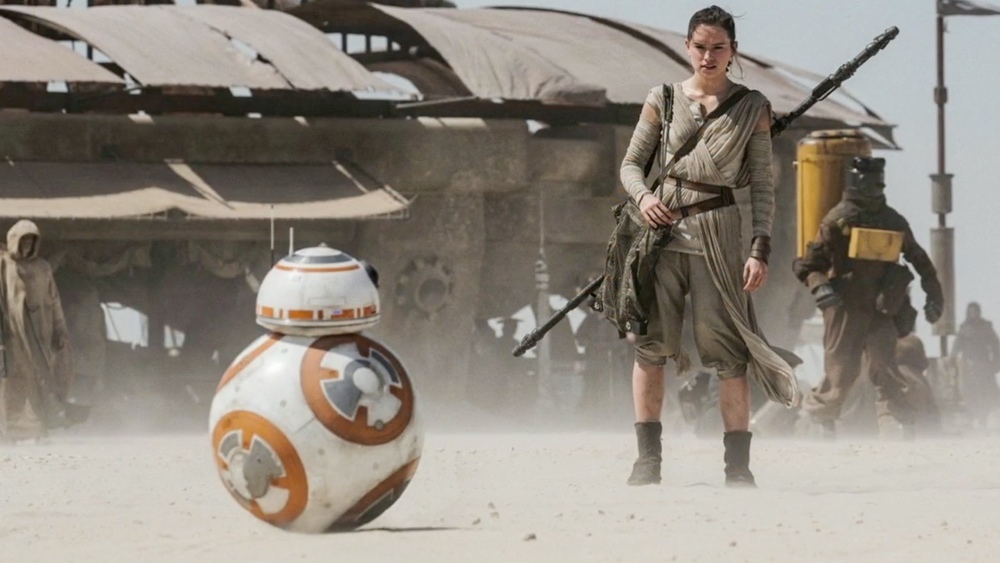
I know. The new Star Wars has been out for weeks - what took me so long? Not to worry. To make up for my tardiness, you get Pat's Top 10 Space Movies of All Time list! - What could be better? I'll give it away here... The Force Awakens does not make the cut. But read my review anyway and then delve into the list. 

_____________________________________________________________________________

Star Wars: Episode VII - New faces, same story


The core appeal of The Force Awakens, and the obvious focus of its writers and director, is the nostalgia of it all. The purpose of this long-awaited first film of the new trilogy, it seems, is not to astound as much as it is to reacquaint. Watching Awakens is like meeting an old high-school friend – a good friend… some one you looked up to maybe. It’s quite exhilarating at first, but the excitement of the encounter wears off as you notice how much your friend has aged, like you, and that your old buddy doesn’t have a lot of news that’s truly interesting, even after all these years.

Although Awakens is the first film of the series not to have George Lucas listed as a writer (insert J.J. Abrams who also directs), its story follows the same course as Lucas’ first three. The Empire is done, having gone the same way as its puny Death Star, and has been replaced by The First Order, which looks much like its predecessor only with bigger weapons. The secular First Order is out to defeat the Republic and rule the galaxy (no change there) and its spiritual controllers from the Dark Side wish to finish the deal by extinguishing the last of the Jedi (and no change there). They are all searching for Skywalker who has disappeared, without trace (maybe), after a vaguely defined betrayal by a student Jedi.

Awakens' strategy is clear throughout; hook and hold with the old while hoping we can imprint enough on what little is new to assure the success of episodes VIII and IX. Fortunately, Star Wars’ far-far-away galaxy is still a very small place, making it easy for Abrams to bring all of the old and new together.  All key planets in the story seem within fractions of light years of each other and key characters are serendipitously closely clustered. Random crashes on planets place our main players within walking distance of each other. But I shouldn’t nitpick… maybe this is just The Force at work. After all, Star Wars has always been an interstellar soap opera – a space western never preoccupied much with the science part of its “Science Fiction”. It’s really part of the franchise’s charm I suppose – spacecrafts banking like F-16’s whether they’re in space or atmosphere. The Millennium Falcon (oops… mini-spoiler… yes, the old bird is back) still looks to have the aerodynamics of a cardboard box but maneuvers like a P-51 when negotiating the trenches of Jakku. Like the old faces we see, however, these quirks will be friendly reminders of familiar and fond places for most.  

So with hooks firmly in place, Abrams attempts to sell the new - new faces that is not new ideas. Abrams shows us a dark helmeted villain, a cocky pilot, and a daydreamer young upstart living on planet Podunk and longing for adventure – hmmm… I know these guys from somewhere. The new faces maneuver in the same places as the old once stood and often in identical ways. There’s nothing wrong in visiting the past. But it’s never quite the same is it. Ford’s Solo is the clear star – giving us glimpses of the old Hans. But they’re just glimpses, barely enough to make up for the disappointing Princess, err… General Leia, who has obviously had a too many packs of Camels while ruling the Republic all these years. Awakens is fun – it’s good and better than the mess heaved upon us in episodes I - III. But at some point we’re going to have to move on aren’t we? Here’s for hoping that episode VIII can better transport us from old to new and and from good to great. Awakens gets a 7 out of 10.

___________________________________________________________________

So Star Wars: The Force Awakens certainly doesn’t rank in my list of Best Space Films. Take a look at what does.

I’ve narrowed the science fiction genre to “Space Films” for this list. There’s a lot of good sci-fi films out their that never leave earth's gravity field - but that's another list. To make this list below, you’ve got to spend some time out there in zero-gravity, in the cold confines of the great vacuum – dealing with whatever you find in that final frontier. But enough of the cliches, Here we go!


Pat's Best Space Movies 


#10 - Apollo 13 (1995)


“Houston, we have a problem” … in space. A gripping true event turned into a gripping film. I admire films that can take a story that everybody knows and still rivet you to your seat. Ron Howard's no-frills direction conveys the isolation and desperation of being lost in space and the lengths taken and ingenuity expended on all sides to return home. Nail biter, tear jerker, and flag waver for the human race all wrapped into one. Sneaks by another real-lifer, The Right Stuff (which would be on the honorable mention list if I had one) to get here.


#9 - Solaris (2002)


Space psychodrama. If you go looking, don’t be fooled by the professional critics when they tell you that the 1972 Solaris is better than the 2002 Hollywood version – they’re movie snobs and these guys always think that the older, non-Hollywood version of anything is better. They’re both good – but I take Clooney in 2002. This is space madness (maybe). Something weird has happened on a space station observing the planet Solaris. A psychologist (Clooney) arrives to investigate, but no one is able to explain exactly what has happened except that memories our becoming real. Surreal, cerebral, ambiguous, and incredibly interesting. A short story that one might give many different meanings to or take many different messages from. 


#8 Star Wars: The Empire Strikes Back (1980)


The best of the Star Wars Series. As big and flashy as the original but the characters have hit their strides in this one. Imaginative and engrossing – best of the space fantasies and the most compelling of the tales of the mythic clash between good and evil.  


#7 - Silent Running (1972)


I doubt that many have seen this early 70’s sci-fier, but Silent Running is an out of the ordinary thing that should be seen. Bruce Dern plays plant-loving botanist Freeman Lowell who happily carries out his duties on the spaceship Valley Forge, a giant orbiting greenhouse which contains the last remaining samples of flora from a now-barren Earth. When Lowell is ordered to destroy his cargo and return home, he is faced with a choice of what lives and what dies.


#6 - 2001 (1968) 


Although not completely accessible without reading Clark's novel maybe, it is still the most beautiful space film. Kubrick conveys the film's arguments with imagery and music in unprecedented fashion. A mesmerizing and cryptic look at beginnings and ends and beyond. So why didn’t I put this on top of my list? That’s a good question. I don’t know.


#5 - Star Trek: The Wrath of Khan (1982)


The Wrath of Kahn represents sweet redemption from the disaster that was the first Star Trek movie. And maybe it is the satisfaction of seeing that the ol’ crew of the Enterprise could hit their stride again that puts Kahn on my list. Ricardo Mantalban creates a top-10 villain and the film is pumped full of cool add-ons; the Kobyayashi Maru Scenario, Spock dies (temporarily), and Khan’s giant chest - and that line... "I have and always will be your friend" - it doesn't get any better. 


#4 - Alien (1979)


One of the best in the science-fiction/Space/horror genre.  The crew of the cargo ship Nostromo lands on a barren planet in response to an SOS signal only to encounter an acid-dripping alien killing machine.  Unlike its revved-up sequel AliensAlien is slow paced tenseness as the crew attempts to search and destroy but finds themselves the hunted instead of the hunters.


#3 - Interstellar (2014)


Interstellar has as much to do with sentiment as it does with outer space. It’s an ambitious composition with big themes. The world has turned against its inhabitants. Blight and global famine have reduced mankind and its governments down to a single focus on survival. The search for a solution includes escaping earth to a new world. Mankind’s exodus will be made possible by the mysterious appearance of a wormhole near Saturn. Its origin is unknown but its timely arrival must be more than a coincidence. Who will win the race against time, man or nature (or man’s nature)? Both the heart and head parts of Interstellar are complex and large-scale things. Some will find the film incredible… others may find it inane as it pits the human attributes of faith and love up against instinct and logic. I obviously found myself in the first of those two categories. 


#2 - Contact (1997)


This is a special movie to me.  The interplay of science (understanding based on observation) and spirituality has permeated my mind for most of my life.  Contact is about the search for life outside of our little planet.  But the movie is more about ideas of fact, faith, and human nature, than the potential scariness or oddities of life beyond ours. The movie has the depth that you would expect from a product based on Carl Sagan’s work – which it is.  A science-fiction core wrapped in a discussion of what we believe and why.


#1 - Aliens (1986)


I’m not sure why I have listed this at #1. Maybe because it’s so much dang fun to watch. Rarely is the sequel better than the first but Aliens is the exception. From where Director Ridley Scott left off with the horror of a single, inexplicable monster in Alien, director James Cameron speeds up the action using legions of monster bugs with Ripley (the lone survivor from the previous encounter) embedded with high-tech Marines to battle them.  This is a modern sci-fi classic and one of my favorite movies of all time. Intense suspense with muscular story telling. 


Saturday, June 6, 2015

Pitch Perfect 2 prevails despite a few flat notes


It must have been hard to decide how to approach making a sequel to the 2012 surprise hit Pitch Perfect. There’s always the question, I presume, of how to maintain the essence of a hit film’s appeal without settling for just creating a duplicate. The balance between what stays and what new directions are added plays a large part in determining whether the sequel is more satisfying than the original. Kay Cannon again produces the script for the film and, although Pitch 2’s setting has been tweaked and there are a few new faces on the screen, she and first time director Elizabeth Banks choose mainly to stay with the stuff that worked the first time. Some of the old and new notes work in Pitch 2 but a few don’t.

At the core of the success of first Pitch Perfect was the A Cappella soundtrack. That’s A Cappella… you know, instrument free singing… making music with your mouth. Yeah, go figure. But if you think I’m off base with that assessment, check out the sales of the Pitch Perfect soundtracks – the first quickly went platinum and the new Pitch 2 album debuted last week at number one on Billboard. The gorgeous harmonizing (ok extremely auto-tuned harmonizing) in Pitch 1 was backed up with a solid cast and an upbeat and life-affirming message, and Pitch 2 tries to hold fast to those winning and money-making attributes. The Barden College Bellas are still singing, cast intact, with the extremely likable Anna Kendrick as Beca now leading the group. The Bellas have put together a string of national championships and are riding high as seniors until a severe wardrobe malfunction befalls Fat Amy, the self-titled, plus-sized soloist played by Rebel Wilson, at a performance for the President and the group is banned from national competition as a penalty. There is a loophole though – the Bellas can still compete Internationally. The deal becomes that if they triumph at the World A Cappella Championship the ban will be lifted – but if they lose, there done for good.  

Like I said – bit of a new setting but the tricks, jokes, and story path are pretty much the same. The Bella girls – with their diverse spirits and talents, and unique quirks, must find themselves again as they pass through a new crossroads. I wont tell you whether they are, in the end, able hit their tonal centre in this new and bigger stage but I will let you in on the off- and on-key notes produced along the way.

A little flat-
  • Marginalizing the Treblemakers – As the Barden Bellas move to the global stage they effectively leave behind their local competitors from Pitch 1, The Barden College Treblemakers. That’s a shame as the all-boy group sounded great and provided the feel-good budding romance between their lead singer Jesse (Skylar Austin) and Kendrick’s Beca. Neither the sound nor the romance is adequately replaced in Pitch 2. 
  • Beca’s identity crisis – The small subplot and gags involving Beca slipping from her true alternative DJ style into a cliché pop-girl and her alarming (to her) attraction to the statuesque female lead of the German A Cappella team, seem like random and late script add-on’s and generally fall flat.  
  • The new Bella Pledge – Hailey Stienfeld (True Grit) as Emily, a freshmen pledge to the Bellas and the only new member to the group, is a complete miss. Stienfeld, who was so good in her starring True Grit role, seems way out of place here and her performance comes off forced and awkward. Stienfeld’s Emily adds little and a new romance between her and the geeky magician Trebleman Benji (Ben Platt) is less interesting than the Beca-Jesse pairing.  

On key-
  • Becas Internship – Becas new job as an intern at a major music production shop working for a major music producer played by Keegan Michael Key (Key and Peele) is the best new piece in Pitch 2. Key’s great as Beca’s I’m-successful-so-I-have-a-right-to-be-rude music boss who turns the browbeating of his want-to-be interns into an art form.
  • The Germans – Pitch 2’s soundtrack is good but does not equal the energy and freshness of the first movie's sound. However, Das Sound Machine from Germany, the reigning World A Cappella Champs, injects some major electricity into the film. For a minute I thought I was watching Dodgeball on The Ocho.
  • Anything that Fat Amy says of does – Removing Wilson’s Fat Amy from this film would be like taking Lebron James off the Cavs – what remains wouldn’t be in the running for much. Regardless of the material she has in Pitch 2, Wilson “crushes” every scene and is good for a laugh in the most awkward of moments. 

Sometimes more of the same is ok. Pitch 2 is not as fresh and energetic as its parent but it’s still fun and has its share of big laughs. A wise man once told me that the key to happiness is lowering your expectations. Expect good, not great, with Pitch 2 and enjoy. 7 out of 10. 


Saturday, May 16, 2015

How does Avengers Age of Ultron match up against Pat's Best Super Hero Movies?


You may be wondering why, after several months without a post, I’ve chosen to review yet another super hero movie instead of something with more substance like say…  Ex Machina. It’s a good point, I admit, as The Avengers age of Ultron turns out to be just another loud and long comic-book action-hero movie – no better and no worse really than most of the group that is slowing reforming, on film, the Marvel Universe (and making boat loads of money while doing it). But I have ulterior motives. Sure, I’ll jot some thoughts down here on the mighty team’s latest chapter, but watching Ultron reminded me of the mediocre nature of the recent mega-hit Avengers, Iron Man, and Captain America films and has motivated me to make… drum roll… yet another list! Yes it’s true! Announcing… louder drum roll with big tympanis behind the snare… Pat’s Top 9 All Time Best Super Hero Movies.

But first, some words on Ultron to allow the suspense and anticipation to build.

Age of Ultron is a very long movie as far as super-hero films go – 2 hours 21 minutes. And yet, with all of this time, writer-director Josh Whedon (Toy Story, X-Men) fails to create any depth of story ­– rushing, instead, fast-forward through the source, reason, and context for his new villains and heroes in a race to get to another machine-filled action scene. And there are more than enough battles to exhaust you, spreading wide across a cacophony of super bells and whisltes like artificial intelligence in Loki’s scepter turned peace keeping robot gone mad, a giant Iron Man, an infinity-stone power-laced human, thousands of metal (but fragile) flying Ultron-bots, brooding eastern European super villains with bad accents wearing obligatory Adidas warm up jackets (see Behind Enemy Lines or any other film with bad guys from countries with names ending in -slovia), and cities hovering above the ground for not-well understood purposes. And for what? To set up the next three blockbuster movies that’s what.

Whedon does try to bring in some non-super-power back-stories but the attempts come off as awkward and a little silly. Take for example the budding romance between Black Widow and the Hulk… ummm… in the words sung by Belle to the The Beast – “new, and a bit… alarming” (hey, Ultron was distributed by Disney so I’ve got a tie). Or the discovery that Hawkeye is just a family guy who sets the table with his wife and helps his kids do their homework, then carpools with Captain America to the next world-saving event – “you be safe dear, and keep your hands off of that Black Widow girl.” Give credit to this edition though for acknowledging the discrepancies in abilities among the Avengers – it always seems odd when danger strikes and Black Widow pulls out her pistol and starts firing 22-caliber bullets along side the god-like powers of Thor and the nigh-invincible strength of the Hulk. But they’re the glue guys we learn – relatively worthless in the fighting arena but holding the more powerful prima donnas of the team together (and wearing tight black leathers in the case of the Widow).

I guess when I agree, sometimes reluctantly, to go to another one of these films, that I’m hoping there will be something different – something that is as fun as the comic books I read as a kid but then more – more of something that I can’t easily explain. Comic-book movies are sort of like soda pop I guess – there are a lot of them in different flavors but they’re all pretty common to us. But on occasion you find a good vanilla coke, like the one I sometimes get at Hires down on 4th South, that has a special balance of coke, vanilla, and that great drive-in crumbly ice that makes you take a second of pause to be thankful for the small blessings of life. Ultron aint one of those special things. It’s cool and marginally refreshing, but it’s just coke in a can and when you’re done, what’s left is just tossed in the recycle bin. 6 out of 10.
_______________________________________________________________________


Pat's Best Super Hero Movies


OK, so now let’s take a look at 9 super-hero films that have that special “something.” My choice of 9 instead of 10 is just a reminder to me that most super-hero films are not made to be great so there should be no surprise that there aren’t even enough good ones to make a top 10 list. I’m sure you’ll disagree with what I’ve got here so let me know what you think. Here we go!

#9 – Hellboy 


Looking at the list as a whole I note that I’ve got some of the darker pieces in here. Hellboy is kind of grimy dark with a character group that may be better described as monster misfits than super heroes. Hellboy is, in fact, an non-malevolent demon working for the Bureau for Paranormal Research and Defense. The character is not a Marvel or DC creation (it was originally published by Dark Horse Comics) and he forms a much more interesting group around him than the Avengers. The Hellboy world is rich and odd with the story and it’s characters given as much attention in the film as the well crafted fight scenes it produces. A refreshing addition to the genre.


#8 – Thor 


Thor is, for me, the Marvel hero that works the best in transition to full-length film. The co-mingling of Norse mythology into the super hero genre seems to fit well on film and provides a rich and surreal setting for interesting story telling. Another key might be the screenplay writing for Thor of Joe Straczynski who wrote for comics and graphic novels before teaming for big-screen efforts – he knows the craft and the two Thor stories to date are much tighter than the hubbub found in the other Avenger heroes’ movies. Thor is beautifully designed and the muscled Hemsworth as Thor, Anthony Hopkins as Odin, and Tom Hiddleston as the wickedly unpredictable Loki form a fascinating triangle among the 9 Realms.


#7 – Watchmen


Different is key here. Sourced from a graphic novel series, it's not quite clear what makes some of these characters super but they are super interesting. And they claim as a team member one of the most fascinating characters of any of my list of nine – Dr. Manhattan (who lives on Mars now I believe). Combine Dr. Manhattan and the Smartest Man in the World with a good story and a catchy ending and you have a memorable super-hero film – which is rare.


#6 – The Crow


Darkly dark. A risen-from-the-dead rock star with a crow as his guide – great starting point for a different type of super-hero film. Maybe most famous for the death if its star, Brandon Lee (son of Bruce Lee), during filming, the film is more scary than action-thriller. Gothic and Poe-like, it crosses horror and science fiction genres to give us a story of the anti-hero vs. a decaying society that is not easily forgotten.


#5 – Superman II


Best of all the Superman movies (how many are there now… 30?). The second sequel film I’ve put on this list – its just much better than the first good but not great Superman offering. Superman II gets right to it. With all the origin description and character building handled in the first installment, the cool trio of villains from Superman’s home planet propels the series to a significant acme. The oldest movie on my list lacks the special effects of the modern super-hero films, but its characters and story telling are much better than what we’ve been getting out of Marvel and DC lately.


#4 – Guardians of the Galaxy


What a joyous surprise. Anti-serious but surprisingly entertaining, Guardians gives a fresh breath to the genre with a dumb (sort of) lunk of a hero and his odd-ball gang of Guardians. Super big and colorful like the comic book it sprang from. Can’t wait for GOTG-II.


#3 – Spiderman II


Spidey has always been my favorite super hero and he hit his stride in this one. Great super villain (Doc-Ock is one of the best), great aunt, and great girlfriend – its like that vanilla coke. Every thing clicked in this one and the out-of-control train ending is superb.


#2 – The Incredible


Just a really good super-hero movie. Don’t get caught in not considering this since it’s Pixar animated. True, the story appeals to kids and adults (and adults who act like kids especially) – but it’s a really, really, really good film.


#1 – Batman Begins


My favorite of all the super hero movies. No cartoony stuff here - no Arnold as Mr. Freeze or DeVito’s sad attempt at a penguin.  The show is elevated in my book by its seriousness and superb balance.  It is a dark drama that is the best origins story of the super-hero genre. The action is surrounded by plot and character.  It’s careful and precise.  And they finally got it right with Bale as the Dark Knight.  


Tuesday, January 20, 2015

Selma


There can be great power in picture, or word, or song. And sometimes the three can be perfectly synchronized, with the impact of one added completely to the other, and the other. This is not always the case with films, even when a movie is treating a subject of great significance. Often the power of a story, or the depiction of a piece of history, is not magnified by a film's components much beyond what we already know. But Selma is one of the exceptions to this norm – it definitely moves the needle. The physicist would call what I describe above “constructive interference” – the synced superposition of multiple energy waves (light or water or other) to form a resultant that has greater magnitude than its parts. Selma rolled over me, the peaks of its wave much higher and valleys much lower than expected even for a re-telling of such a dramatic and pivotal period of American history.

Selma benefits, I believe, from not having to cover the whole Martin Luther King Jr. story. Instead, the film's power is packed into the three months surrounding the civil rights protest march from Selma Alabama to the State’s capital, Montgomery, in 1965. The march was organized in protest of severe discrimination in access to voting in the south. The Civil Rights Act, outlawing discrimination based on race and color, had been signed in 1964. Black people could legally vote in 65, but numerous racial local policies kept most from even being able to register in the south. Director Ava DuVernay and screenwriter Paul Webb show us both the front and back of this time, marching us into the raw emotions of the many protesting in the streets and the incomprehensible cruelty visited on them, but also through the nasty political juggling of the few power players in the back rooms. All are laid bare to some degree in Selma. King’s (David Oyelowo) charisma is displayed along side his flaws and weaknesses, and, most interestingly, his doubts about the outcome of his cause and even in his ability to carry it through. President Lyndon Johnson (Tom Wilkinson) is portrayed as more an adversary than an ally to King, coming at this issue of life-changing magnitude with the same long-term goal as King, but from a different world – as Johnson reminded King in one heated exchange, “you’re an activist and I’m a politician… you’ve got one big issue and I have a hundred and one.” Johnson knew he needed public sentiment to gather sufficient momentum before he could introduce and pass a voting rights bill and King knew that it could not wait. DuVernay’s portrayal of the impasse is impressive as is Oyelowo’s and Wilkinson’s portrayal of the two main characters in the struggle.

There are many imperial scenes in Selma – the act of terrorism that ignites the story, the impasse at the Edmund Pettus Bridge, King being confronted by his wife, Coretta (Carmen Ejogo) on past infidelities – and Oyelowo is in the best of them. He’s not on the list of best actor nominees but he probably should be. The bottom line is that you should see this film, and not just because of the importance of the subject matter. Somebody said to me before I saw Selma that I really was going to have to like the film because of what it was about. Yes, I benefited from being reminded of the events, both terrible and wonderful, of this turning point in American history, but DuVernay’s telling of it burned them into me, the actors held them hard to me so I could not forget them. 9 out of 10.

Monday, January 5, 2015

Into the Woods loses its way along the path


Even moviegoers unfamiliar with the story line from the Tony-winning stage musical will know, from the first few scenes of Into the Woods, that this new fairy tale is going to have some edge to it. “Into the woods to bring the bread, to Granny who is sick in bed,” sings Little Red Riding Hood (Lilla Crawford); “Never can tell what lies ahead, for all that I know she’s already dead.” But the promise of an irreverent tale played out by an all-star cast gets lost on the trail somehow - the telling of this twist on familiar myths not quite clever enough, the drama of it not quite moving enough, the score note quite memorable enough to push this uneven adaptation of the Stephan Soundheim (lyrics)-James Lapine (book) play beyond being just an interesting time passer. Into the Woods is fun in places, but lacks the magic and exhilaration found in the really good film musicals – even in the dark ones. 

Into the Woods’ story is a convolution of several Brothers Grimm fairy tales with five stories and their characters running concurrently through a single intersection point – the woods. Eventually all the stories’ characters enter the woods – Red Ridding Hood to visit her grandmother, Jack (Daniel Huttlestone, Les Miserables) on his way to the village to sell the cow, Cinderella (Anna Kendrick, Perfect Pitch) running home from the ball chased after by the handsome Prince (Chris Pine, Kirk from Star Trek), and Repunsel sequestered there by a Wicked Witch (Meryl Steep). The Witch starts the multiple tales in motion by sending a Baker (James Cordin) and his Wife (Emily Blunt – The Edge or Tomorrow) into the woods on a scavenger hunt of sorts with the promise that success will bring them a desired child. 

It was the above-listed grade-A cast that drew me to this film on its opening week, pulling me from Unbroken or Big Eyes or Exodus.  And all of the stars, big and small, perform well to very well – handling Sondheim’s complex wordplay lyrics with seeming ease. Streep’s screen-gobbling Evil Witch and Kendrick’s prototypical Disney vocals were no shock, but Blunt and Pine surprise with strong musical performances and the latter delivering the film’s finest comic number, “Agony”, belting out, with his brother prince, a sappy ballad about their lost or unreachable loves. But Director Rob Marshall (Chicago) can’t maintain the energy of that bright spot. The film’s pace sputters – it revs and stalls its way to the end of the first act where the tale downshifts hard into a darker state. 

The woods, we learn, is a place where you never know what you’ll find, where knowledge is gained, the good kind and the tough kind, and where interests and goals collide causing collateral damage or alliances, or both. I have not seen the theatrical production for reference, but this seems to be the message parsed out in the intertwining tales – that life is not a fairy tale and you never know what will happen. I say seems to be, because the morals of the stories, delivered through witty verse, are numerous, sometimes disparate, with multiple sub-messages. And after sifting through the unsteady tone and shape of the telling, it turns out to be a message that I, and everybody else who has lived more than a few decades, is all too familiar with. Into the Woods does not have the spark sufficient to make the message new or its musical delivery memorable for more than a few seconds. Heck, if I’m going to sit through 130 minutes of pithy message tunes telling me something I already know, I’m going to need one of them to be catchy enough to hum on the way out – but none of them stuck. 5 out of 10. 

Saturday, November 15, 2014

Interstellar


Interstellar rolls on like a long crescendoing symphony: Adagio movement – the dying earth, Allegro – space, and Scherzo – the black hole. And although the planets and the void provide a gorgeous and fascinating (if not confusing) structure to the opus, this song has as much to do with sentiment as it does with outer space. It’s an ambitious composition with big themes. Both the heart and head parts of Interstellar are complex and large-scale things, and you’ll need to stay frosty to hang in if you see it.

Interstellar’s space-time anthem takes place in an earth time – maybe not too far in the future it seems – when the world has turned against its inhabitants. Blight and global famine have reduced mankind and its governments down to a single focus on survival. Society is dotted with advanced technology – relics of what was. But the little that is left is not maintained, given up on for the more basic cause of putting food on the table. Technology is almost shunned as if maybe it were the cause of earth’s current challenges. This makes Cooper, our protagonist played by Matthew McConaughey, an anachronism on his rapidly changing earth – he’s an engineer and space pilot with no more ships to fly. He farms now, like most others do, and rages against the blight and the dust hoping, like most others do, that the next year and the next crop will be better… but it wont be better. 


Peculiar circumstances guide Cooper, a widower raising two children on his corn farm (one of the few crops that will grow these days), and his high-IQ daughter Murphy to what is left of NASA. There, Cooper meets back up with an old mentor and teacher, Professor Brand (Michael Caine), who is working on an escape strategy for those left on the dying earth. Mankind’s exodus will be made possible by the mysterious appearance of a wormhole near Saturn. Its origin is unknown but its timely arrival must be more than coincidence. NASA has sent missions through the hole already and has identified three potentially habitable planets. They are preparing an experimental spacecraft to travel through the hole to recover the previous missions’ data and determine if there is a suitable planet. Coop is the perfect pilot for this trip but there is a catch ­– traveling through the wormhole messes with time. What will be weeks and months for the travelers will be years on earth. This, Professor Brand explains, will give him time to solve the main problem of moving all of humanity to the new home… gravity, but those Coop leaves behind will be much older than him, or worse, if and when he returns.

Those with music backgrounds will likely be commenting in their head to me that the first movement of a symphony is usually fast paced – not an adagio. They’d be right of course, but Interstellar is a slow starter. It even feels a bit awkward as we trudge through the motivation for it all and get used to McConaughey as an astronaut and, oh yeah, Anne Hathaway as an astrophysicist (Brand’s daughter). But writer and director Christopher Nolan (Batman Begins, Inception) must set up the dissonance – what guided Cooper to NASA, where did the worm hole come from, who wins the race against time, man or nature (or man’s nature)? – I told you it was ambitious. But every thing starts to harmonize in space where McConaughey and the rest hit their stride.


The influences of past sci-fi film makers on Interstellar are very evident – Nolan has admitted as much: the space ballets of 2001: A Space Odyssey, and the used feel of Aliens’ ships and space stations for examples. But the story is more closely comparable to that of Contact – big and bold and beyond us sometimes. Some will find Nolan’s resolution in Interstellar to consonance incredible… others may find it inane as he pits the human attributes of faith and love up against instinct and logic. He’s trying to cover all bases, striving for the cold science and beauty of 2001 and the heart and magic of Spielberg films like Close Encounters of the Third Kind. Yes, Interstellar is a very, very ambitious work. Not all of the film’s goals are completely obtained I think – they seem just outside of an impossible reach. But it gets us most of the way there and that feels like more than enough. 8 out of 10.

Tuesday, November 4, 2014

Fury


“War is hell”, my father would tell me when I was a boy, was not just a catch phrase, but the gospel truth. "There is little glory in it," he would teach, "it’s mostly just pain and death." He'd know about war I figured, having fought in two of them - he wore a long panel of ribbons on his chest when he went to work each morning and those ribbons matched the heavy medals I would dig out of the bottom of the cedar chest sometimes... stars and crosses and eagles. Yeah, he'd know I figured, and so I believed him.  And having viewed Furys trailers, I was prepared to be reminded of that truth when I bought the ticket. But Fury director David Ayer isn’t content with just a reminder of what I already thought that I knew; he is committed, in Fury, to drag us up and down and through the devil's hot house - and then back and forth across it again and again until that message becomes like a mantra given forth in repeated and graphic displays of physical, mental and spiritual pain - pounding over and over again until we’ve learned the lesson.

Fury is an examination of the depth and height of human behavior in war, set during the last month of the European Theater of WWII (April 1945). The allies are making a final surge through Germany - the outcome of the war is certain. And yet Germany is commanded by its fuehrer to fight on, including now it's women and children, in defense of the motherland - an order gruesomely enforced by the dreaded SS. A battle-weary tank crew commanded by U.S. Army Staff Sergeant Don "Wardaddy" Collier (Brad Pitt) is slugging it out against a sporadic but still deadly defense. The veteran team in the M4A3E8 Sherman tank, named Fury, has been together from North Africa, through Normandy, to here. The crew has lost its bow gunner - dead in the tank as it pulls into a rendezvous base. There, the gunner is replaced by Norman Ellison (Logan Lerman, Percy Jackson: Sea of Monsters). Normans never been inside of a tank, never seen combat, and is a subtraction not an addition to the tightly bonded Fury team - I promised my crew a long time ago I'd keep them alive… you’re standing in the way of that.” Collier tells the petrified private.

It takes a while for Ayer to get to the payoff part of the film - the desperate situation of the crew’s disabled tank in the path of an advancing enemy force. The first half of the film is spent getting to know Fury’s crew. They’ve lived through several hells and it’s taken its toll on each of them. Ayer’s soldiers, all those appearing on the screen it seems, are not only physically scarred but mentally damaged. They are hard and vulgar, their feel for human life muffled – there is no benevolence in Ayer’s war. The crew's humanity has been stripped away leaving little else but loyalty to themselves – even to Norman eventually. Pitt shines here, amidst the artillery, the fire and smoke, as the scarred patriarch of these men. But a surprisingly brighter glow comes from Shia Lebeouf as Boyd "Bible" Swan, the only believer in the crew until Norman comes along. His character is more interesting than Pitt’s and the more believably played up against the over the top atrocities of Collier and the debauchery of Grady "Coon-Ass" Travis (Jon Bernthal, The Walking Dead), the tanks loader Lebeouf nails it.

The detail in Fury is exceptional, from the uniforms to the armament (real Shermans and the only working German Tiger Tank on the planet). But for a film with such attention to detail and with so much care taken to obtain realism, I was disappointed that Fury’s long battle finale was an artificial device – an unreal encounter. The contrivance provides the opportunity for a glorious (oddly) end story and some deep ( I suppose) visual symbolism, but it seems suddenly out of place and severely weakens the film. Fury is grey and grim. It is tense, at least in its second half. It is uncomfortable, disturbing and often wrenching. But, by the end, the film is less significant than these attributes would lead to believe. Unfortunately, Fury's whole is somehow less than the sum of it's parts. And yet… still a 7 out of 10.